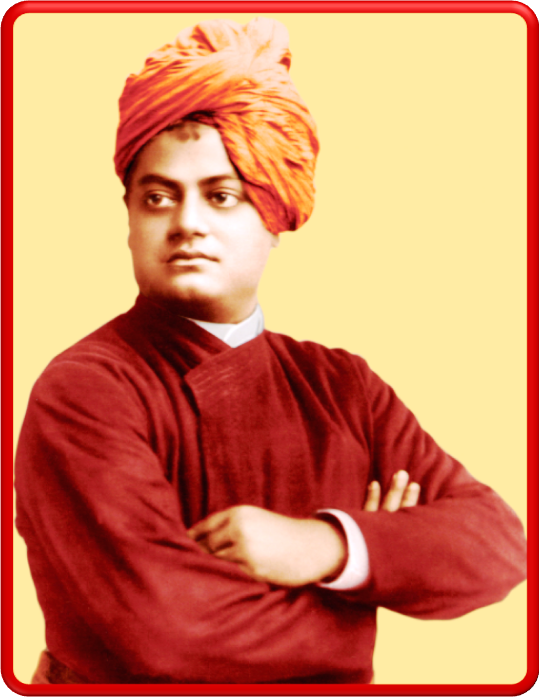
Great Teachers of the World taught his Disciples and Devotees through Stories. Swami Vivekananda was an Expert Story Teller. They have both charm and Spiritual Benefit for the Readers.
SL.NO. STORY TITLE REMARKS
1. RISE YOURSELF THROUGH YOUR OWN DUTY - See Below 2. Each is great in his own place - See Below
3. COMPLETE SELF – SACRIFICE- See Below
4. YOU ARE A MIGHTY LION - [ Click here ] ------------------------------------------------------
1.RISE YOURSELF THROUGH YOUR OWN DUTY:
A young Sannyâsin went to a forest; there he meditated, worshipped, and practiced Yoga for a long time. After years of hard work and practice, he was one day sitting under a tree, when some dry leaves fell upon his head. He looked up and saw a crow and a crane fighting on the top of the tree, which made him very angry. He said, "What! Dare you throw these dry leaves upon my head!" As with these words he angrily glanced at them, a flash of fire went out of his head — such was the Yogi's power — and burnt the birds to ashes. He was very glad, almost overjoyed at this development of power — he could burn the crow and the crane by a look.
After a time he had to go to the town to beg his bread. He went, stood at a door, and said, "Mother, give me food." A voice came from inside the house, "Wait a little, my son." The young man thought, "You wretched woman, how dare you make me wait! You do not know my power yet." While he was thinking thus the voice came again: "Boy, don't be thinking too much of yourself. Here is neither crow nor crane." He was astonished; still he had to wait.
At last the woman came, and he fell at her feet and said, "Mother, how did you know that?" She said, "My boy, I do not know your Yoga or your practices. I am a common everyday woman. I made you wait because my husband is ill, and I was nursing him. All my life I have struggled to do my duty. When I was unmarried, I did my duty to my parents; now that I am married, I do my duty to my husband; that is all the Yoga I practice. But by doing my duty I have become illumined; thus I could read your thoughts and know what you had done in the forest. If you want to know something higher than this, go to the market of such and such a town where you will find a Vyâdha (The lowest class of people in India who used to live as hunters and butchers.) who will tell you something that you will be very glad to learn." The Sannyasin thought, "Why should I go to that town and to a Vyadha?" But after what he had seen, his mind opened a little, so he went.
When he came near the town, he found the market and there saw, at a distance, a big fat Vyadha cutting meat with big knives, talking and bargaining with different people. The young man said, "Lord help me! Is this the man from whom I am going to learn? He is the incarnation of a demon, if he is anything." In the meantime this man looked up and said, "O Swami, did that lady send you here? Take a seat until I have done my business." The Sannyasin thought, "What comes to me here?" He took his seat; the man went on with his work, and after he had finished he took his money and said to the Sannyasin, "Come sir, come to my home."
On reaching home the Vyadha gave him a seat, saying, "Wait here," and went into the house. He then washed his old father and mother, fed them, and did all he could to please them, after which he came to the Sannyasin and said, "Now, sir, you have come here to see me; what can I do for you?" The Sannyasin asked him a few questions about soul and about God, and the Vyadha gave him a lecture which forms a part of the Mahâbhârata, called the Vyâdha-Gitâ. It contains one of the highest flights of the Vedanta. When the Vyadha finished his teaching, the Sannyasin felt astonished. He said, "Why are you in that body? With such knowledge as yours why are you in a Vyadha's body, and doing such filthy, ugly work?" "My son," replied the Vyadha, "no duty is ugly, no duty is impure. My birth placed me in these circumstances and environments. In my boyhood I learnt the trade; I am unattached, and I try to do my duty well. I try to do my duty as a householder, and I try to do all I can to make my father and mother happy. I neither know your Yoga, nor have I become a Sannyasin, nor did I go out of the world into a forest; nevertheless, all that you have heard and seen has come to me through the unattached doing of the duty which belongs to my position."
* * * * *
2. EACH IS GREAT IN HIS OWN PLACE:
A certain king used to inquire of all the Sannyasins that came to his country, "Which is the greater man — he who gives up the world and becomes a Sannyasin, or he who lives in the world and performs his duties as a house holder?" Many wise men sought to solve the problem. Some asserted that the Sannyasin was the greater, upon which the king demanded that they should prove their assertion. When they could not, he ordered them to marry and become householders. Then others came and said, "The householder who performs his duties is the greater man." Of them, too, the king demanded proofs. When they could not give them, he made them also settle down as householders.
At last there came a young Sannyasin, and the king similarly inquired of him also. He answered, "Each, O king, is equally great in his place." "Prove this to me," asked the king. "I will prove it to you," said the Sannyasin, "but you must first come and live as I do for a few days, that I may be able to prove to you what I say." The king consented and followed the Sannyasin out of his own territory and passed through many other countries until they came to a great kingdom. In the capital of that kingdom a great ceremony was going on. The king and the Sannyasin heard the noise of drums and music, and heard also the criers; the people were assembled in the streets in gala dress, and a great proclamation was being made. The king and the Sannyasin stood there to see what was going on. The crier was proclaiming loudly that the princess, daughter of the king of that country, was about to choose a husband from among those assembled before her.
It was an old custom in India for princesses to choose husbands in this way. Each princess had certain ideas of the sort of man she wanted for a husband. Some would have the handsomest man, others would have only the most learned, others again the richest, and so on. All the princes of the neighbourhood put on their bravest attire and presented themselves before her. Sometimes they too had their own criers to enumerate their advantages and the reasons why they hoped the princess would choose them. The princess was taken round on a throne, in the most splendid array, and looked at and heard about them. If she was not pleased with what she saw and heard, she said to her bearers, "Move on," and no more notice was taken of the rejected suitors. If, however, the princess was pleased with any one of them, she threw a garland of flowers over him and he became her husband.
The princess of the country to which our king and the Sannyasin had come was having one of these interesting ceremonies. She was the most beautiful princess in the world, and the husband of the princess would be ruler of the kingdom after her father's death. The idea of this princess was to marry the handsomest man, but she could not find the right one to please her. Several times these meetings had taken place, but the princess could not select a husband. This meeting was the most splendid of all; more people than ever had come to it. The princess came in on a throne, and the bearers carried her from place to place. She did not seem to care for any one, and every one became disappointed that this meeting also was going to be a failure. Just then came a young man, a Sannyasin, handsome as if the sun had come down to the earth, and stood in one corner of the assembly, watching what was going on. The throne with the princess came near him, and as soon as she saw the beautiful Sannyasin, she stopped and threw the garland over him. The young Sannyasin seized the garland and threw it off, exclaiming, "What nonsense is this? I am a Sannyasin. What is marriage to me?" The king of that country thought that perhaps this man was poor and so dared not marry the princess, and said to him, "With my daughter goes half my kingdom now, and the whole kingdom after my death!" and put the garland again on the Sannyasin. The young man threw it off once more, saying, "Nonsense! I do not want to marry," and walked quickly away from the assembly.
Now the princess had fallen so much in love with this young man that she said, "I must marry this man or I shall die"; and she went after him to bring him back. Then our other Sannyasin, who had brought the king there, said to him, "King, let us follow this pair"; so they walked after them, but at a good distance behind. The young Sannyasin who had refused to marry the princess walked out into the country for several miles. When he came to a forest and entered into it, the princess followed him, and the other two followed them. Now this young Sannyasin was well acquainted with that forest and knew all the intricate paths in it. He suddenly passed into one of these and disappeared, and the princess could not discover him. After trying for a long time to find him she sat down under a tree and began to weep, for she did not know the way out. Then our king and the other Sannyasin came up to her and said, "Do not weep; we will show you the way out of this forest, but it is too dark for us to find it now. Here is a big tree; let us rest under it, and in the morning we will go early and show you the road."
Now a little bird and his wife and their three little ones lived on that tree, in a nest. This little bird looked down and saw the three people under the tree and said to his wife, "My dear, what shall we do? Here are some guests in the house, and it is winter, and we have no fire." So he flew away and got a bit of burning firewood in his beak and dropped it before the guests, to which they added fuel and made a blazing fire. But the little bird was not satisfied. He said again to his wife, "My dear, what shall we do? There is nothing to give these people to eat, and they are hungry. We are householders; it is our duty to feed any one who comes to the house. I must do what I can, I will give them my body." So he plunged into the midst of the fire and perished. The guests saw him falling and tried to save him, but he was too quick for them.
The little bird's wife saw what her husband did, and she said, "Here are three persons and only one little bird for them to eat. It is not enough; it is my duty as a wife not to let my husband's effort go in vain; let them have my body also." Then she fell into the fire and was burned to death.
Then the three baby-birds, when they saw what was done and that there was still not enough food for the three guests, said, "Our parents have done what they could and still it is not enough. It is our duty to carry on the work of our parents; let our bodies go too." And they all dashed down into the fire also.
Amazed at what they saw, the three people could not of course eat these birds. They passed the night without food, and in the morning the king and the Sannyasin showed the princess the way, and she went back to her father.
Then the Sannyasin said to the king, "King, you have seen that each is great in his own place. If you want to live in the world, live like those birds, ready at any moment to sacrifice yourself for others. If you want to renounce the world, be like that young man to whom the most beautiful woman and a kingdom were as nothing. If you want to be a householder, hold your life a sacrifice for the welfare of others; and if you choose the life of renunciation, do not even look at beauty and money and power. Each is great in his own place, but the duty of the one is not the duty of the other.
* * * *
3. COMPLETE SELF – SACRIFICE:
After the battle of Kurukshetra the five Pandava brothers [heroes of the Mahabharatha Epic] performed a great sacrifice and made very large gifts to the poor. All people expressed amazement at the greatness and richness of the sacrifice, and said that such a sacrifice the world had never seen before.
But, after the ceremony, there came a little mongoose, half of whose body was golden, and the other half brown, and he began to roll on the floor of the sacrificial hall. He said to those around, “You are all liars; this is no sacrifice.” “What!” they exclaimed, “You say this is no sacrifice; do you not know how money and jewels were poured out to the poor and every one became rich and happy? This was the most wonderful sacrifice any man ever performed.”
But the mongoose said: “there was once a little village, and in it there dwelt a poor Brahmin, with his wife, his son and his son’s wife. They were very poor and lived on small gifts made to them for preaching and teaching. There came in that land a three years’ famine, and the poor Brahmin suffered more than ever. At last when the family had starved for days, the father brought home one morning a little barely flour, which he had been fortunate enough to obtain, and he divided it into four parts, one for each member of the family. They prepared it for their meal, and just as they were about to eat there was a knock at the door. The father opened it, and there stood a guest. Now, in India, a guest is a sacred person; he is a god for the time being, and must be treated as such. So the poor Brahmin said, ‘Come in sir; you are welcome.’ He set before the guest his own portion of the food, which the guest quickly ate and said, ‘Oh, sir you have killed me; I have been starving for ten days, and this little bit has but increased my hunger.’ Then the wife said to her husband, give him my share,’ but the husband said, Not so.’ The wife however insisted, saying, Here is a poor man, and it is our duty as householders to see that he is fed, and it is my duty as a wife to give him my portion, seeing that you have no more to offer him.’ Then she gave her share to the guest, which he ate, and said he was still burning with hunger. So the son said, “Take my portion also; it is the duty of a son to help his father to fulfill his obligations.’ The guest ate that, but remained still unsatisfied; so the son’s wife gave him her portion also. That was sufficient, and the guest departed blessing them. That night those four people died of starvation.
A few granules of that flour had fallen on the floor, and when I rolled my body on them half of it became golden, as you see. Since then I have been travelling all over the world, hoping to find another sacrifice like that, but nowhere have I found one; nowhere else has the other half of my body been turned into gold. That is why I say this is no sacrifice.’
SOURCE: Complete Works of Swami Vivekananda


 About an hour passed. A man came wearing a black shirt and a black cap. He asked a devotee: “Sir, does Ramakrishna Paramahamsa live here? I have come to see him. Could I see him right away?” “Of course,” replied the devotee. He took him to Sri Ramakrishna’s room [now kept as a shrine room].